Shop
High Protein on a Budget
Plan a cheap high-protein week, rank your store's foods by protein per dollar, and catch the AI's math errors.
See real pages and a sample: High Protein on a BudgetKits
Each kit: copy-paste prompts for ChatGPT, Gemini or Claude, an example answer for every prompt with the numbers checked by us, and the sources.
Or one kit for 9 USD below. PDF + copy-paste prompts, instant download on Payhip.
Shop
Plan a cheap high-protein week, rank your store's foods by protein per dollar, and catch the AI's math errors.
See real pages and a sample: High Protein on a Budget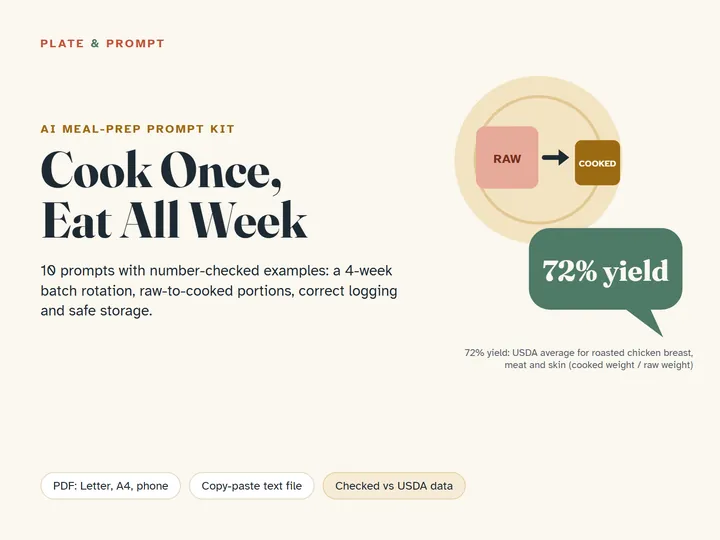
Cook
Turn raw and cooked weights into equal portions, log meal prep correctly, and store it within food-safety times.
Launch code COOK30: 30% off until Oct 16, 23:59 UTC.
See real pages and a sample: Cook Once, Eat All Week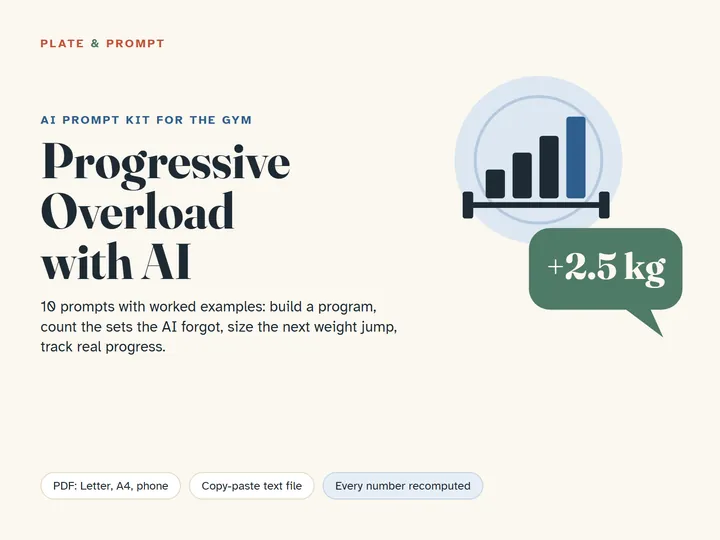
Train
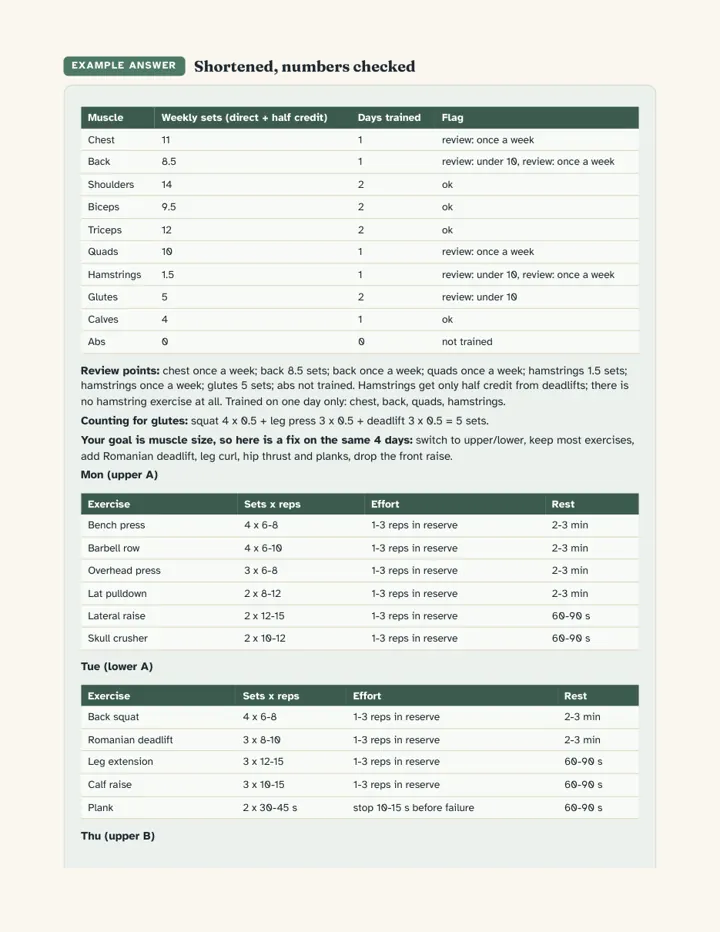
Build and audit a gym program: sets per muscle, every weight jump as a percentage, rest counted in session time.
Launch code TRAIN30: 30% off until Oct 16, 23:59 UTC.
See real pages and a sample: Progressive Overload with AI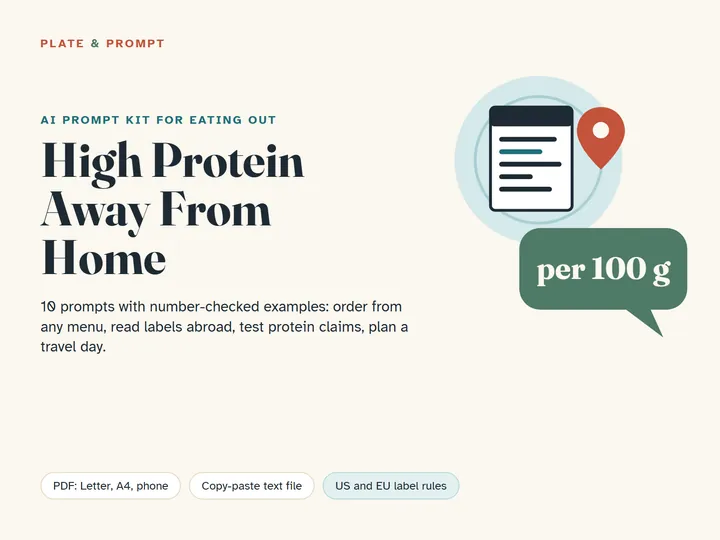
Eat out and travel
Pick high-protein choices from a menu, read food labels abroad (kJ, per 100 g), and plan a travel day.
Launch code AWAY30: 30% off until Oct 16, 23:59 UTC.
See real pages and a sample: High Protein Away From Home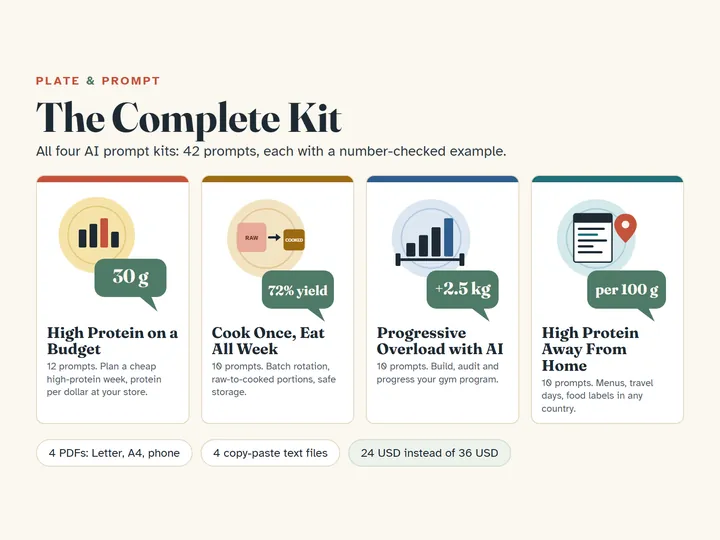
All four
All four kits in one download: 42 prompts, the same files as the single kits.
At regular prices, one by one: 4 x 9 USD = 36 USD.
The Complete Kit: 24 USD, 12 USD less.
Until Oct 16 the launch codes bring four single kits to 27.90 USD (9 + 3 x 6.30): the Complete Kit still saves 3.90 USD.
Each kit: PDF in US Letter, A4 and phone size, plus the prompts as plain-text and Markdown files. One payment, instant download. Not medical, nutrition or training advice.
A closer look · Kit 1 of 4
12 AI prompts for ChatGPT, Gemini and Claude, each with an example answer we recomputed from USDA and BLS data.
24-page PDF (Letter, A4, phone) + copy-paste prompts · secure checkout on Payhip · 14-day refund
The start of Prompt 2, as you get it
You are a budget meal planner who is careful with numbers.
My details:
- Weekly food budget: [AMOUNT and CURRENCY] for [NUMBER] people
- Country and store: [for example: US, Walmart / UK, Aldi]
- Protein target: [GRAMS] g per day per person
- Diet style: [omnivore / vegetarian / halal / ...]
...plus cooking time, equipment, foods you avoid, and the five things the AI must return, ending with its check step. See the checked answer it produced or read Prompt 8 in full, free.
Rendered straight from the file you download. Open a page to see it full size.
Prompt 2's example answer, as printed in the kit. Weights are before preparation: meat raw, rice and beans dry, canned corn drained, fruit without peel.
| Meal | Foods, raw or dry weight | Protein | kcal |
|---|---|---|---|
| Breakfast: 3 eggs scrambled + 2 slices toast | eggs 150 g, white bread 58 g | 24.0 g | 369 |
| Lunch: chicken, rice and corn bowl (batch A) | raw chicken breast 230 g, dry white rice 64 g, canned corn 40 g, tomato 70 g | 57.8 g | 549 |
| Dinner: beef and bean chili over a potato (batch B) | dry pinto beans 64 g, raw 80/20 ground beef 64 g, tomato 70 g, potato 200 g, cooking oil 13.5 g | 29.4 g | 671 |
| Snack: 3 cups 1% milk + 1 banana | 1% milk 732 g, banana 118 g | 26.0 g | 412 |
| Day total | 137.2 g | 2,001 |
| Item | What to buy for 7 days | US average price | Checkout | Sources and notes |
|---|---|---|---|---|
| Eggs, large | 21 eggs: 2 dozen | $2.27 per dozen | $4.54 | FDC 171287 BLS APU0000708111 |
| White bread | 406 g: 1 x 20 oz loaf | $1.82 per lb | $2.28 | FDC 174924 BLS APU0000702111 |
| Chicken breast, boneless, skinless | 1,610 g: 3.75 lb | $4.17 per lb | $15.65 | FDC 171077 BLS APU0000FF1101 |
| White rice, dry | 448 g: 1 x 1 lb bag | $1.11 per lb | $1.11 | FDC 169756 BLS APU0000701312 |
| Canned corn | 280 g drained: 1 x 15.25 oz can | $1.27 per lb | $1.21 | FDC 169214 BLS APU0000714221 Priced on the full can (15.25 oz net at $1.27 per lb). USDA: about 298 g drained per can; 280 g of it is eaten. |
| Tomatoes | 980 g: 2.25 lb | $1.98 per lb | $4.45 | FDC 170457 BLS APU0000712311 |
| Dried pinto beans | 448 g: 1 x 1 lb bag | $1.63 per lb | $1.63 | FDC 175199 BLS APU0000714233 |
| Ground beef 80/20 | 448 g: 1 x 1 lb pack | $6.92 per lb | $6.92 | FDC 174036 BLS APU0000703112 |
| White potatoes | 1,400 g: 3.25 lb | $0.976 per lb | $3.17 | FDC 170026 BLS APU0000712112 |
| Milk, 1% | 21 cups: 3 half-gallons | $3.71 per gallon | $5.57 | FDC 170872 BLS APU0000FJ1101 Half-gallons priced at half the gallon average, which is optimistic. |
| Bananas | 7 bananas: one 3 lb bag | $0.652 per lb | $1.96 | FDC 173944 BLS APU0000711211 |
| Total | $48.49 |
Food actually eaten this week: $45.23; unused portions of the packs carry over. Not priced: cooking oil (about 95 g a week, already in the calories), salt and spices.
Protein and kcal: USDA FoodData Central, SR Legacy (olive oil FDC 171413). Prices: BLS Average Price Data, U.S. city average, August 2026. Totals are computed before rounding.
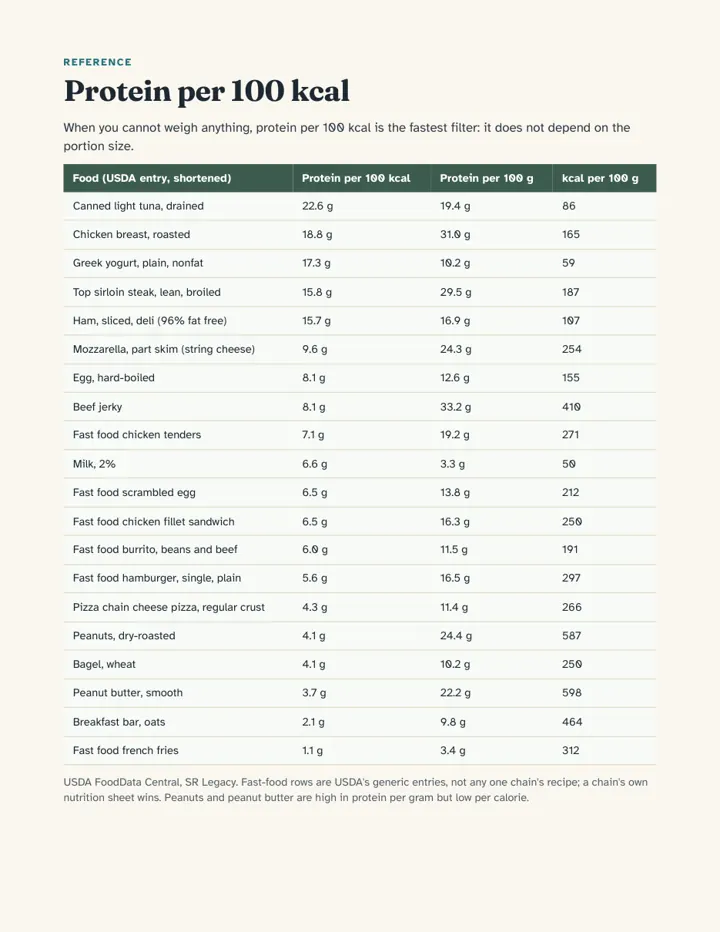
Why not just ask "make me a cheap high-protein plan"? The planning prompts (like Prompt 2) spell out what that request leaves open: raw or dry weights, a shopping list in real pack sizes with guesses marked, and a printed check step. How you use them:
Not medical or nutrition advice, and no promises of weight loss or muscle gain. If you have a medical condition, are pregnant, or take medicines, talk to a doctor or dietitian before changing how much protein you eat.
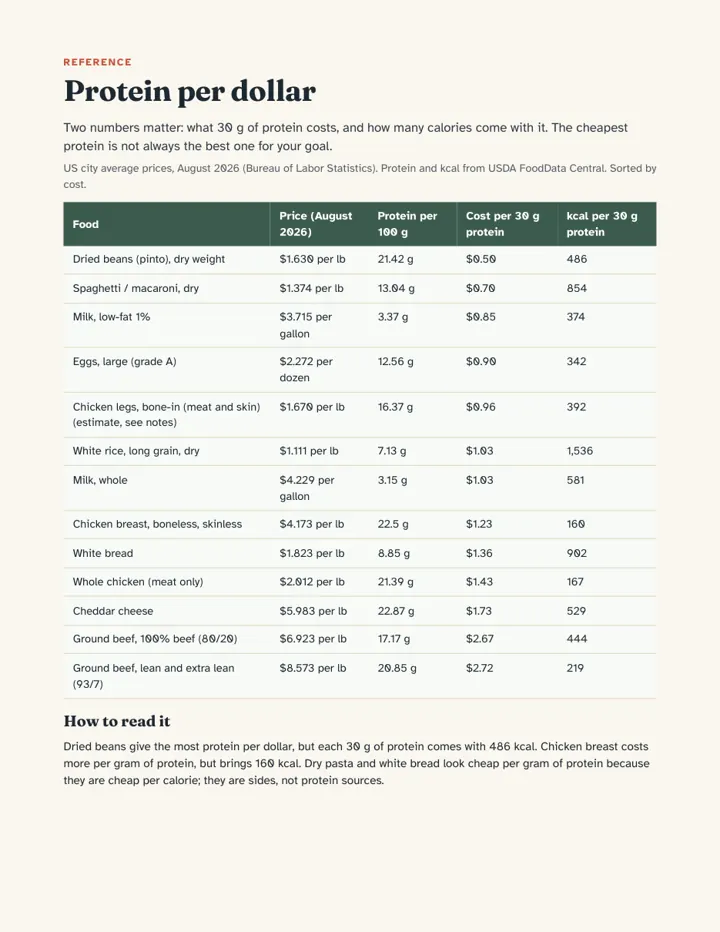
Prices in the examples are US averages. Your store will differ, which is what Prompt 3 is for.
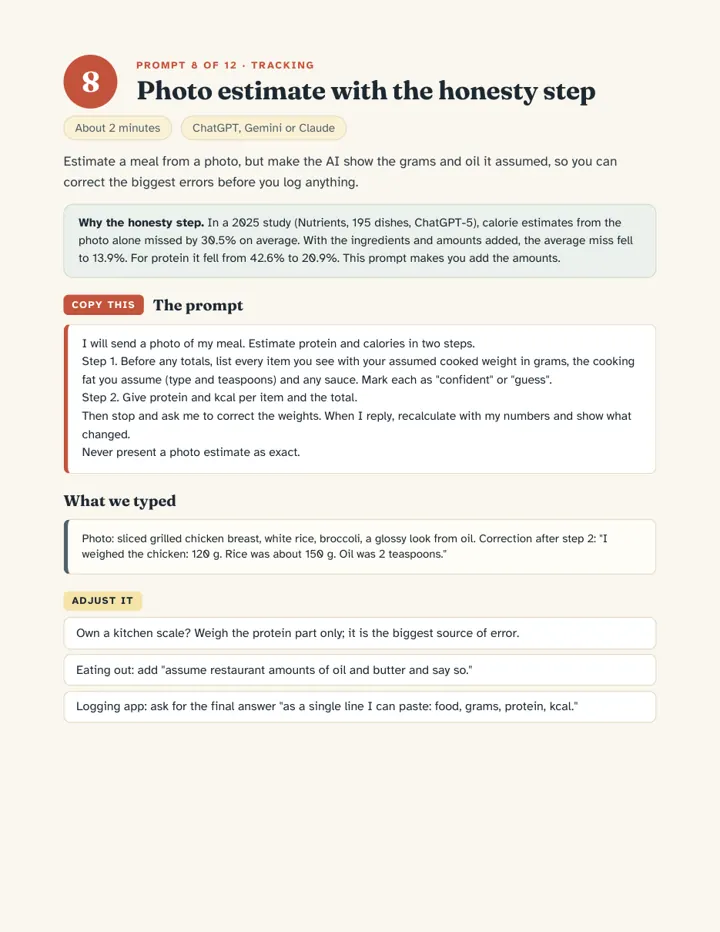
The photo estimate with the honesty step: the prompt asks the AI to show the grams and oil it assumed before any totals, so you can check and fix them.
I will send a photo of my meal. Estimate protein and calories in two steps.
Step 1. Before any totals, list every item you see with your assumed cooked weight in grams, the cooking fat you assume (type and teaspoons) and any sauce. Mark each as "confident" or "guess".
Step 2. Give protein and kcal per item and the total.
Then stop and ask me to correct the weights. When I reply, recalculate with my numbers and show what changed.
Never present a photo estimate as exact.
Photo: sliced grilled chicken breast, white rice, broccoli, a glossy look from oil. Correction after step 2: "I weighed the chicken: 120 g. Rice was about 150 g. Oil was 2 teaspoons."
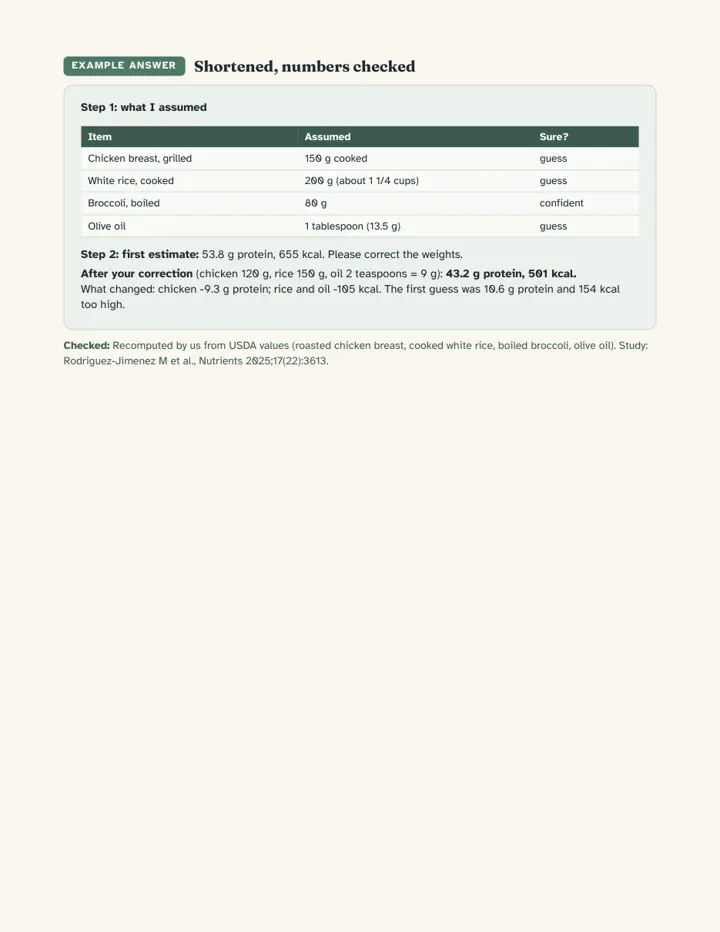
| Item | Assumed | AI's own label |
|---|---|---|
| Chicken breast, grilled | 150 g cooked | guess |
| White rice, cooked | 200 g (about 1 1/4 cups) | guess |
| Broccoli, boiled | 80 g | confident |
| Olive oil | 1 tablespoon (13.5 g) | guess |
First estimate
53.8 g
protein, 655 kcal
After the correction
43.2 g
protein, 501 kcal
"Confident" and "guess" are the AI's labels for its weight assumptions, not ours. The first guess was 10.6 g of protein and 154 kcal above the corrected estimate. Listing the assumptions makes the difference easy to trace.
Checked: recomputed by us from USDA values: roasted chicken breast (FDC 171477), cooked white rice (169757), boiled broccoli (169967), olive oil (171413). The example answer was generated with Claude, then shortened.
A closer look · Kit 2 of 4
10 prompts for batch cooking: your own raw-to-cooked yield, equal portions, correct logging and safe storage times.
9 USD 22-page PDF with recipe cards + copy-paste prompts
Get the kit · 9 USDPrompt 2 of 10, as you get it
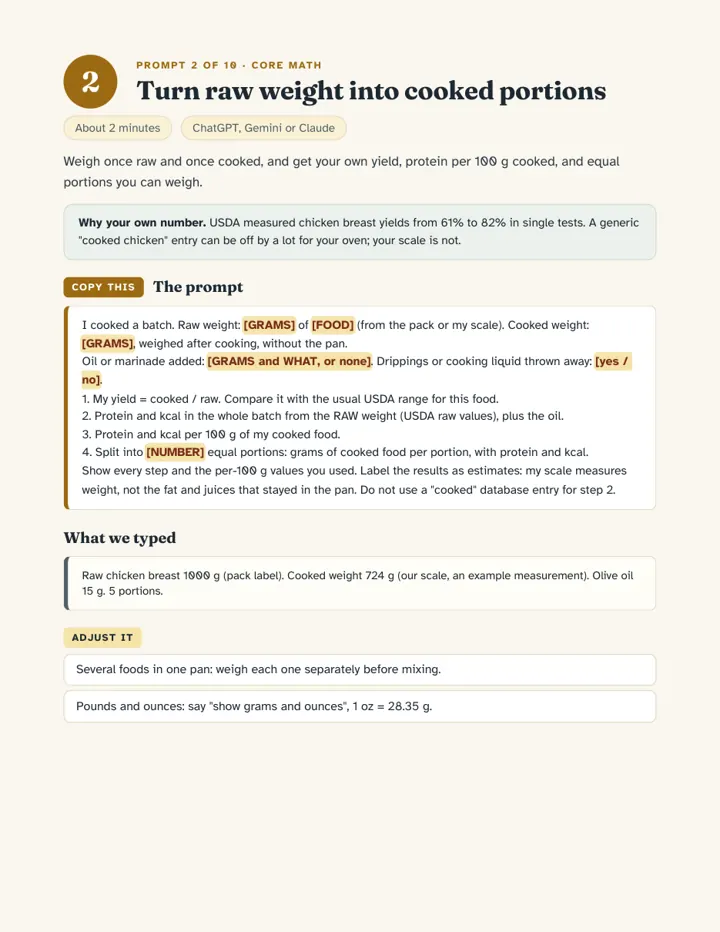
I cooked a batch. Raw weight: [GRAMS] of [FOOD] (from the pack or my scale). Cooked weight: [GRAMS], weighed after cooking, without the pan.
Oil or marinade added: [GRAMS and WHAT, or none]. Drippings or cooking liquid thrown away: [yes / no].
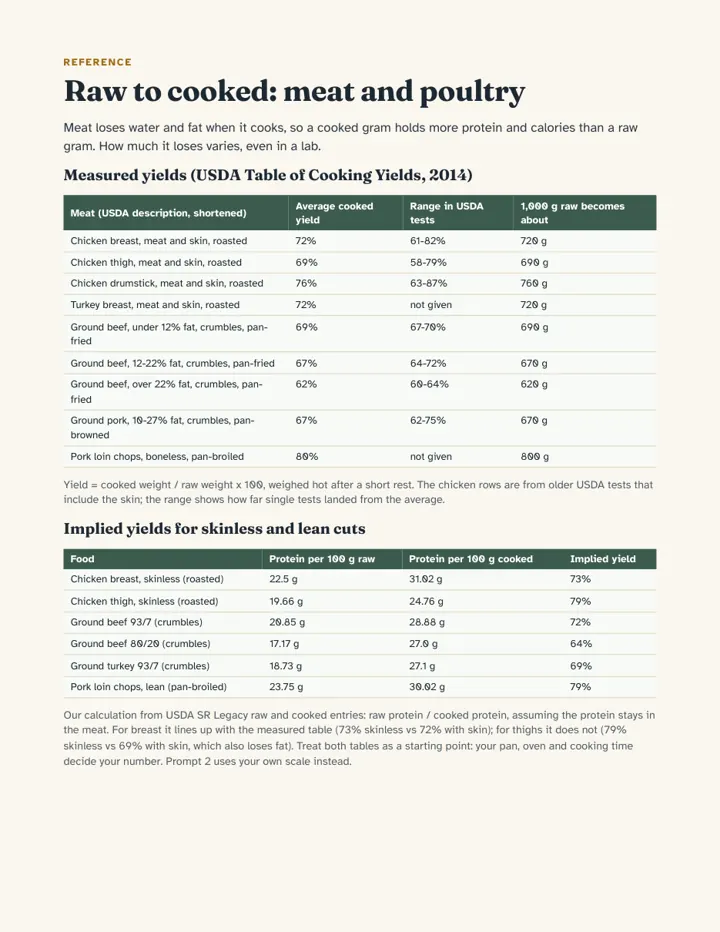
1. My yield = cooked / raw. Compare it with the usual USDA range for this food.
2. Protein and kcal in the whole batch from the RAW weight (USDA raw values), plus the oil.
3. Protein and kcal per 100 g of my cooked food.
4. Split into [NUMBER] equal portions: grams of cooked food per portion, with protein and kcal.
...plus two rules: show every step, and label the results as estimates. What we typed: raw chicken breast 1000 g, cooked weight 724 g, olive oil 15 g, 5 portions.
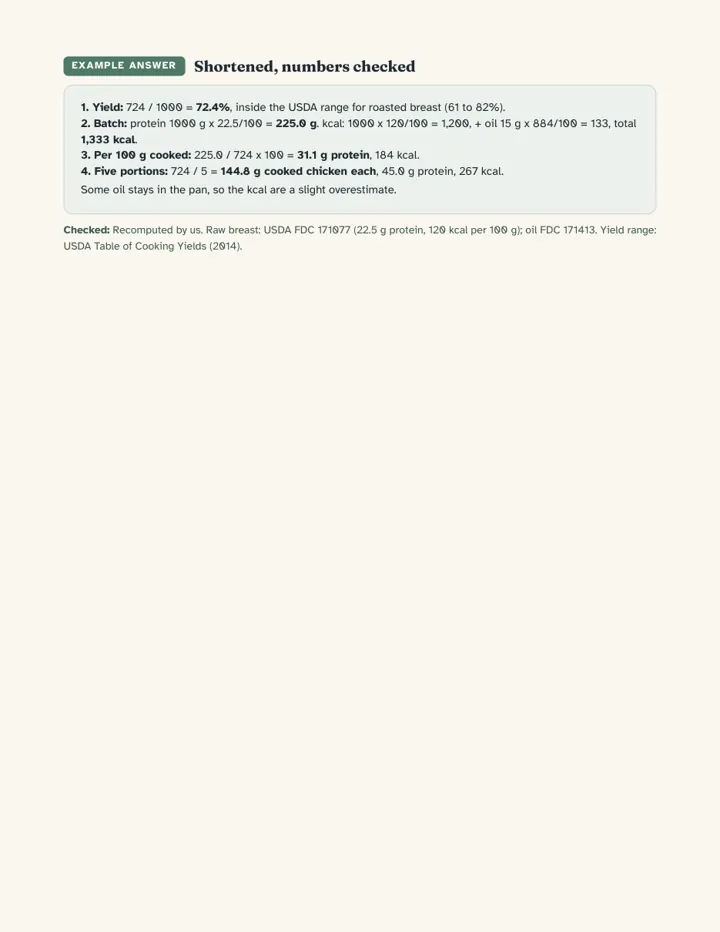
Its example answer, shortened, numbers checked
Recomputed by us: raw breast USDA FDC 171077, olive oil FDC 171413, yield range from the USDA Table of Cooking Yields (2014).
A closer look · Kit 3 of 4
10 prompts to build, audit and progress a gym program, with every weight jump and set count shown.
9 USD 25-page PDF + copy-paste prompts
Get the kit · 9 USDPrompt 6 of 10, as you get it
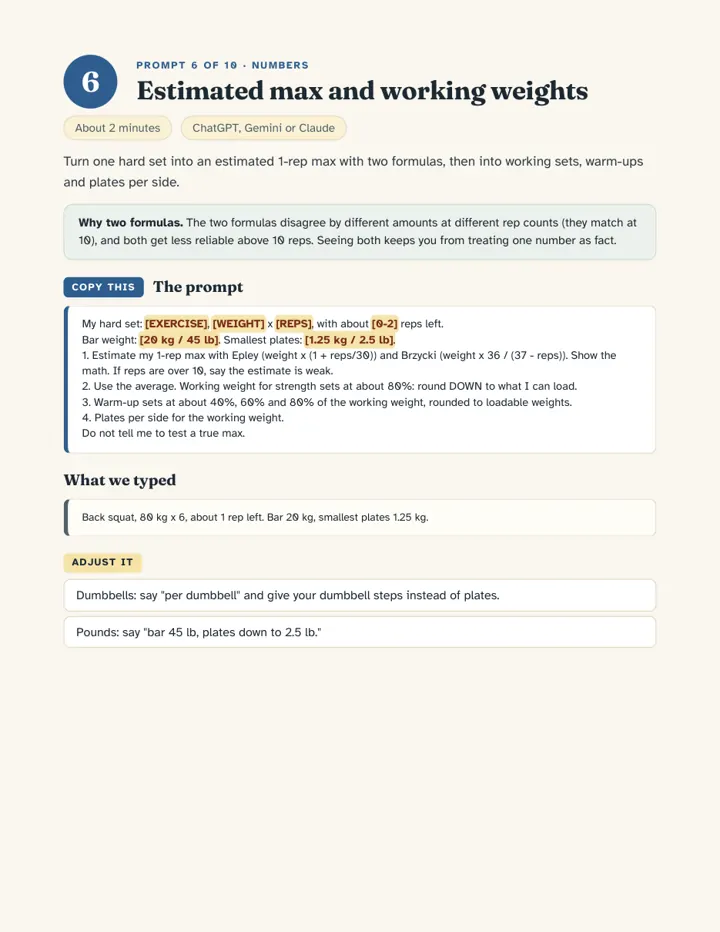
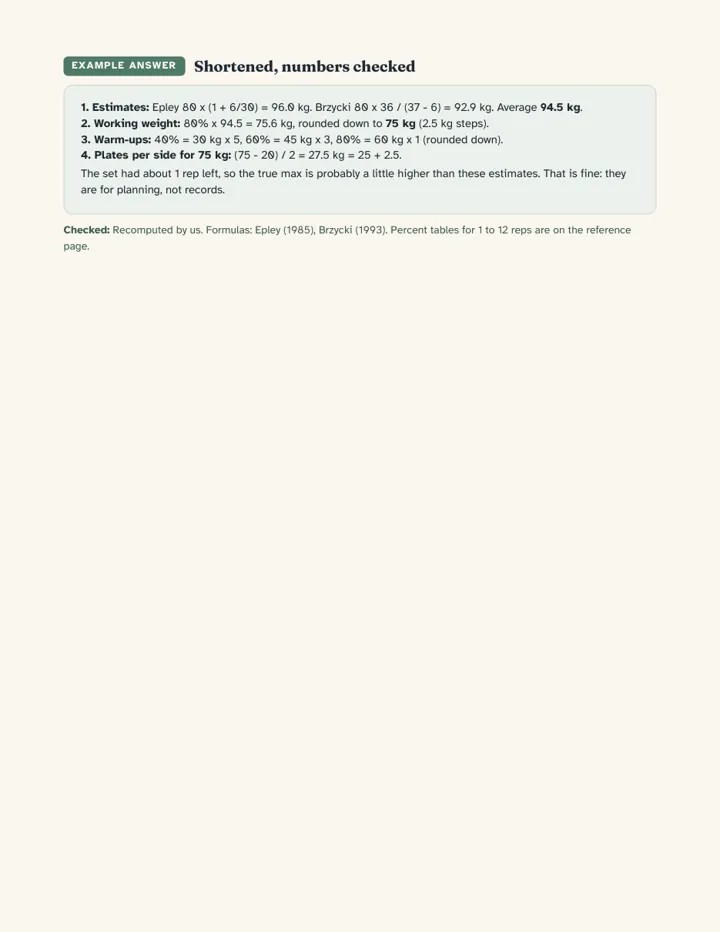
My hard set: [EXERCISE], [WEIGHT] x [REPS], with about [0-2] reps left.
Bar weight: [20 kg / 45 lb]. Smallest plates: [1.25 kg / 2.5 lb].
1. Estimate my 1-rep max with Epley (weight x (1 + reps/30)) and Brzycki (weight x 36 / (37 - reps)). Show the math. If reps are over 10, say the estimate is weak.
2. Use the average. Working weight for strength sets at about 80%: round DOWN to what I can load.
...plus warm-up sets, plates per side, and "do not tell me to test a true max". What we typed: back squat, 80 kg x 6, about 1 rep left, bar 20 kg, smallest plates 1.25 kg.
Its example answer, shortened, numbers checked
Recomputed by us. Formulas: Epley (1985), Brzycki (1993). Estimates are for planning, not records.
A closer look · Kit 4 of 4
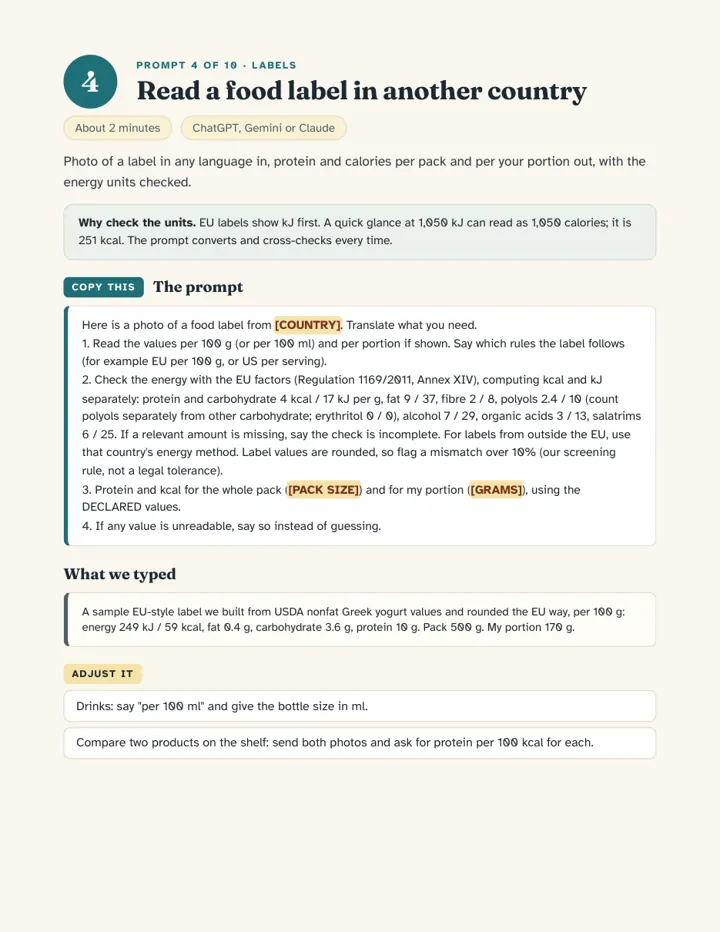
10 prompts for restaurants, food labels in other countries and travel days without a kitchen.
9 USD 22-page PDF + copy-paste prompts
Get the kit · 9 USDPrompt 4 of 10, as you get it
Here is a photo of a food label from [COUNTRY]. Translate what you need.
1. Read the values per 100 g (or per 100 ml) and per portion if shown. Say which rules the label follows (for example EU per 100 g, or US per serving).
2. Check the energy with the EU factors (Regulation 1169/2011, Annex XIV), computing kcal and kJ separately ...
3. Protein and kcal for the whole pack ([PACK SIZE]) and for my portion ([GRAMS]), using the DECLARED values.
4. If any value is unreadable, say so instead of guessing.
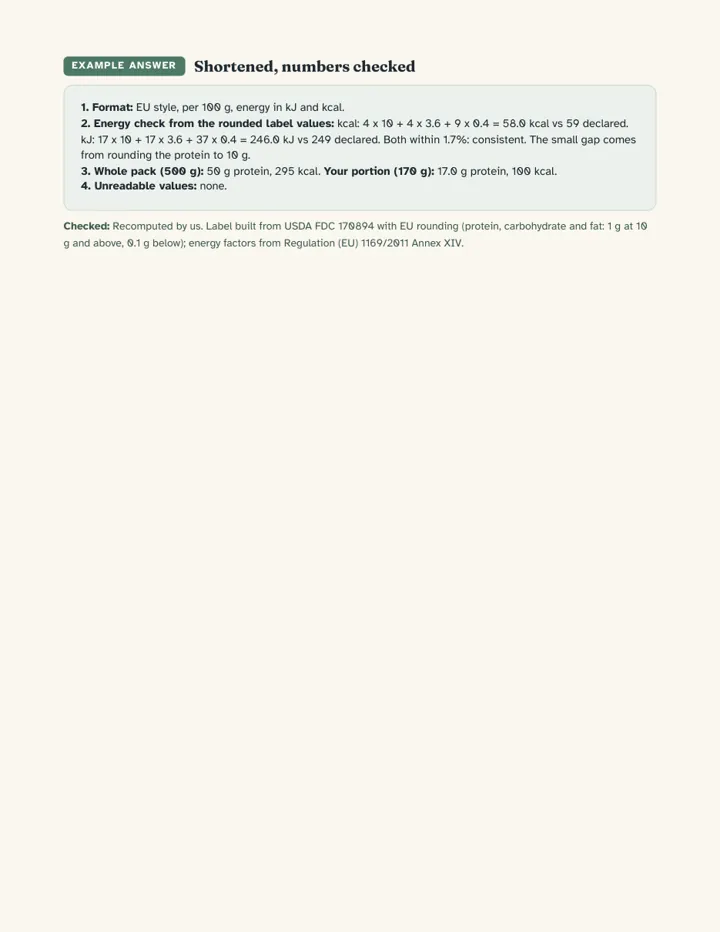
What we typed: an EU-style label built from USDA nonfat Greek yogurt values, per 100 g: 249 kJ / 59 kcal, fat 0.4 g, carbohydrate 3.6 g, protein 10 g. Pack 500 g, portion 170 g.
Its example answer, shortened, numbers checked
Recomputed by us. Label built from USDA FDC 170894 with EU rounding; energy factors from Regulation (EU) 1169/2011, Annex XIV.
Free download
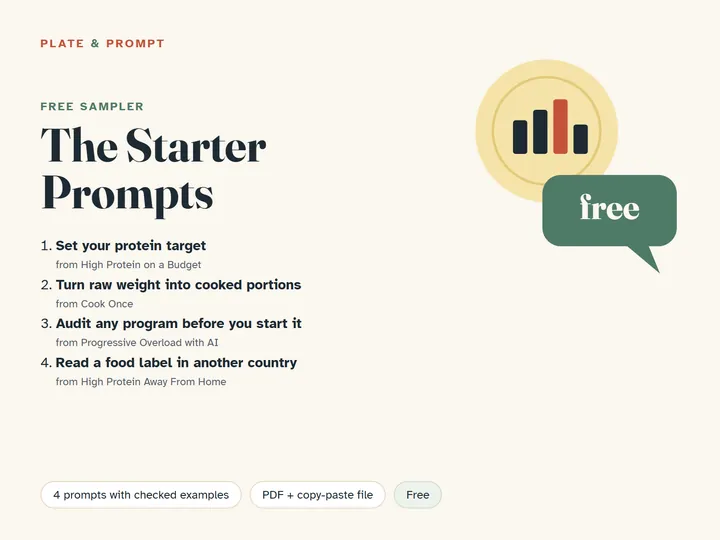
One week of lunches and dinners for about $2.03 a meal and 34 g of protein per meal: an 11-page PDF with 5 recipes, the grocery list and the math behind every number (BLS prices, USDA nutrition). Bonus file: 4 copy-paste AI prompts to set your protein target, turn raw weight into cooked portions, audit a gym program and read a food label in another country.
Payhip asks for your email to send the download, plus occasional Plate & Prompt updates. Unsubscribe any time. See privacy.
No. The prompts were written for the free versions of ChatGPT, Gemini and Claude. The example answers were made with Claude in October 2026. The photo prompts need an assistant that accepts images; free plans may limit how many images you can send.
Yes. The prompts ask for your country, store and prices. The reference table and the worked examples use US prices.
It is a set of prompts that build a plan around your budget, store, target and diet. One full example week is included: about 137 g of protein a day, and a modeled basket of 48.49 USD at US average prices, before oil, salt and spices.
The prompts, structure, checks and notes are ours. The example answers were generated with Claude, then we recomputed every number from USDA and BLS data. Other assistants will word answers differently.
14 days, no questions asked. Write to [email protected] with your order number.
9 USD
Get it on PayhipCheckout and download are handled by Payhip.